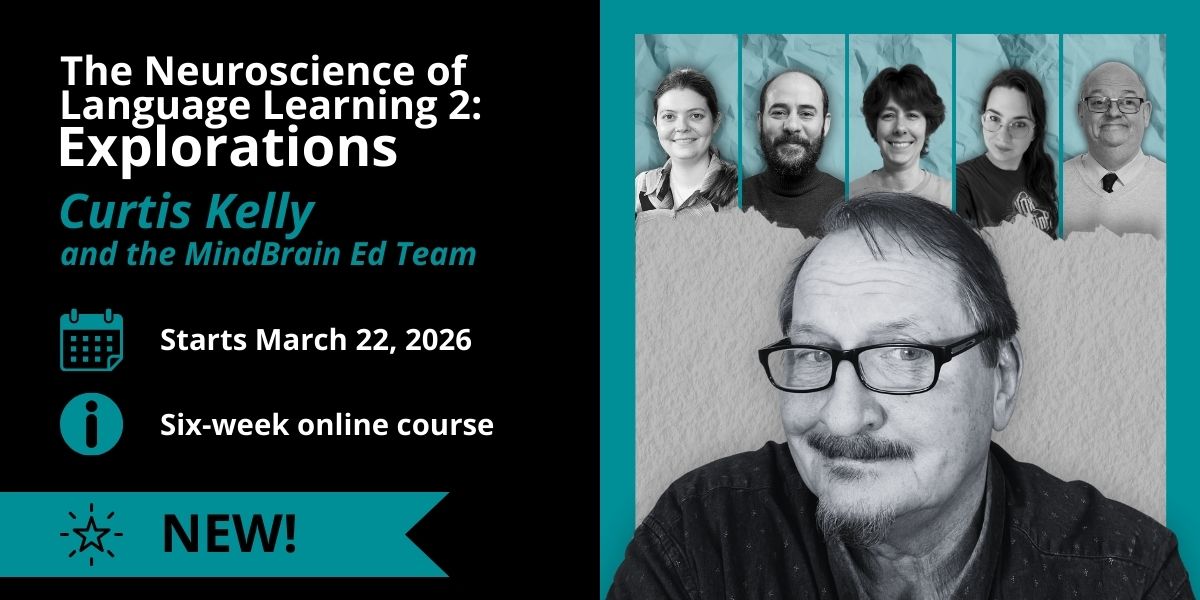
Description
Why are teens so peer conscious? Are my introverted students just shy? Why are some teachers such disciplinarians while others take a nurturing approach? How does my teaching help children grow? And do the emotions I arouse benefit or hamper learning? How can I deal with AI in the language classroom?
If you wonder about these things, then this course, on the neuroscience of language learning, might be just the right one for you. We guarantee that you’ll often be surprised, amazed, and certainly moved. So please join our closely-bound community of caring teachers that see language learning from the brain’s perspective.
By completing this course, you will become an iTDi-certified Brain-Specialist Educator, which, in this age of neuroscience, is especially attractive to educational institutions.
The easy-to-understand Neuroscience of Language Learning 2 course is a continuation of the first course (although you do not have to take the first course to join this one). In the first course, we explored the neuroscience and psychology of the social brain, the language brain, and the learning brain, with the second course building on that understanding. The first module on the developing brain will examine how our brains and abilities change from childhood to adulthood, and how that determines how teachers should teach. The second module on the neurodiverse brain will look at different kinds of brains and how that affects learning. The third module on the teaching brain will explore the psychology behind different approaches, teacher self-care, and dealing with difficult learners. And as in the first course, the last module will offer language teaching methods and brain-compatible teaching.
The course offers videos you can watch at your own rate, heart-warming stories, live sessions, sharing takeaways, and optional assignments and progress quizzes.
Four modules will be covered during this 6-week course:
The Developing Brain
The Neurodiverse Brain
The Teaching Brain
The Language Teaching Methods Brain
Course Orientation live session: March 22. One live session at 12:00 UTC (Check your local time)
After that, there will be two live session times each week to best include all of the time zones represented by members.
Dates for live sessions: March 28, April 5, 12, 19, 26, and May 3
Time for live sessions:
Live session 1
Sundays at 03:00 UTC (Check your local time)
Note: This will happen on Saturday in the Americas and Sunday in Europe and Asia.
Live session 2
Sundays at 20:00 UTC (Check your local time)
Note: This will happen on Sunday in the Americas and Europe, and Monday in Asia.
Cost: 280 USD
We can provide receipts for research funds, if needed.
Registration includes pre-recorded content and resources for each of the four modules, four live sessions, and unlimited private forum discussions. Upon successful completion of the course, participants will have the option of receiving a certificate of achievement.